





Column
Getting Skin Treatments in Seoul: Pores, Acne Scars, Pigment, Downtime
- Pores / Blackheads
- Acne / Scars
- Pigmentation / Melasma / Blemish / Lentigo Treatment
- DUAL PICO TATTOO REMOVAL
- OPUS Detox
- Mirajet
- RETOO Booster
- CORAGE 2.0
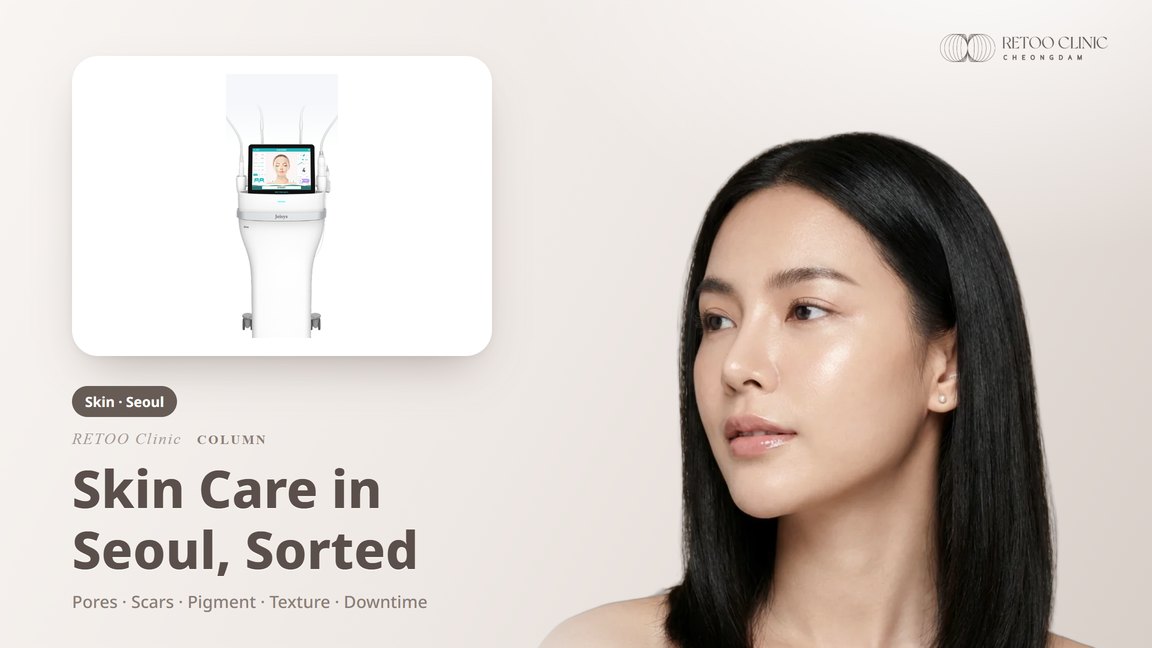
Pores, acne scars, pigmentation, firmness and texture can look like one skin problem, but each has a different cause, so each is handled by a different treatment: RF microneedling (Potenza), plasma RF (OPUS), picosecond lasers (Dual Pico), needle-free skin boosters (Mirajet) or QMR (CORAGE). Medical Director Dr. Kim Jae-rim of Cheongdam RETOO Clinic explains which treatment fits which concern, how downtime differs, how combined treatments are sequenced, and what to know on a short Seoul trip.
Contents
- 01Before getting skin treatments in Seoul, what should you figure out first?
- 02What treatments work for enlarged pores and acne scars?
- 03What treats pigmentation, melasma and red marks?
- 04What helps with firmness, texture and sensitized skin?
- 05How much downtime do different skin treatments have?
- 06Can I combine skin treatments, and in what order?
- 07How do I fit skin treatments into a short Seoul trip?
- 08How does Cheongdam RETOO Clinic plan skin treatments for overseas visitors?
Before getting skin treatments in Seoul, what should you figure out first?
Sort out the cause before you pick a treatment. "Pores" can mean pores that have stretched because skin has lost firmness, or pores that have widened from excess oil, and the two are treated differently. "Acne scars" can mean indented scars or leftover pigmentation and red marks, and those call for different devices. Once the cause is clear, the treatment follows, and once the treatment is set, so are the downtime and the schedule.
That's also where Cheongdam RETOO Clinic's approach to pore treatment begins. Enlarged pores have many causes, including increased oil production, loss of firmness and coarser hair, so the choice between tightening, oil-gland treatment, collagen regeneration and radiofrequency depends on whether stretched pores or oil-enlarged pores dominate. Pigmentation, too, comes in many forms: melasma, lentigines, freckles, blemishes, nevus of Ota and more. How strong and how fast treatment can go depends on your skin type and how well your skin regenerates.
What treatments work for enlarged pores and acne scars?
When the structure inside the skin has changed, as with indented scars and stretched pores, the tool is a radiofrequency device that heats the dermis and drives collagen regeneration. At Cheongdam RETOO Clinic, that mainly means Potenza and OPUS RF Pixel.
POTENZA, made by Jeisys Medical, is an RF microneedling device. People often call it the "Potenza laser," but it doesn't use light. Fine needles enter the dermis and release radiofrequency energy from their tips, creating a coagulation zone around each one [1]. Skin resistance (impedance) is measured in real time during treatment to calibrate the energy. In monopolar mode the heat spreads into deeper layers; in bipolar mode it concentrates in the shallower layer near the needle tip [1]. The basic rule is to go deep when fibrous tissue deep in the dermis needs treating, as with indented acne scars, and shallow when the problem is lost firmness in the upper dermis, as with stretched pores.
OPUS is a radiofrequency platform from Alma in Israel, and OPUS Detox is the name of Cheongdam RETOO Clinic's program that combines its four handpieces to suit your skin. One of them, RF Pixel (Opus Plasma), works fractionally: small electrodes at the tip of the handpiece release RF from just above the skin, creating tiny plasma sparks that open microchannels in the epidermis while coagulating the dermis beneath [5][6]. Because no needle goes in, and it refines the surface while heating the dermis, it's the first option considered for surface texture and stretched pores.
| Concern | Cause | What Cheongdam RETOO Clinic looks at fir |
|---|---|---|
| Indented acne scars | Fibrous tissue deep in the dermis · volume loss | Potenza RF microneedling + collagen-regenerating injections such as Skin Regeneration Inje |
| Stretched pores · surface texture | Loss of firmness in the upper dermis | OPUS RF Pixel · Potenza in shallow mode |
| Oil-enlarged pores | Increased oil production | Oil-gland treatment · combined with skin boosters |
| Recurring acne | Inflammatory · comedonal acne · skin type | Medication · oil-gland reduction · inflammation-control treatment |
If you're still breaking out, treating the acne itself comes before treating scars. Cheongdam RETOO Clinic looks at whether inflammatory or comedonal acne dominates and at your skin type, then tailors medication, oil-gland reduction and inflammation-control treatment. Indented scars are filled in gradually with treatments chosen to match the scar type: collagen-regenerating injections such as Skin Regeneration Injection and Juvelook, Potenza, pico lasers and PTT.
What treats pigmentation, melasma and red marks?
For color inside the skin, such as melanin pigment and tattoo ink, picosecond lasers are the foundation. A picosecond is one trillionth of a second. Picosecond lasers deliver energy far faster than the previous generation of nanosecond lasers, breaking pigment particles into fine fragments with a shockwave (the photoacoustic effect) rather than heat [3]. The smaller the fragments, the more easily the body clears them, and the less heat spreads to surrounding tissue [3].
Cheongdam RETOO Clinic runs two pico lasers side by side, an approach it calls "Dual Pico," to handle pigmentation and tattoos separately. PicoSure® Pro uses a single 755 nm alexandrite wavelength with a pulse duration of 500–900 picoseconds. At 755 nm, the melanin-to-blood absorption ratio is three times higher than at 1064 nm, so energy concentrates in pigment [2]. PicoWay® offers four wavelengths, 532, 730, 785 and 1064 nm, switched by handpiece, and is used to match the wavelength to ink color and skin type [3].
- Centered on the 755 nm PicoSure Pro · wavelength chosen for pigment depth and skin type ·
- Vascular laser · RF redness treatment · regenerative skin boosters together · every 3–4 we
Broad, shallow pigment like melasma and deep pigment like nevus of Ota are first distinguished with a skin analyzer, and the wavelength is chosen to match. Pigmentation treatment at Cheongdam RETOO Clinic combines pigment lasers such as PicoSure, PicoWay and Harmony Lite with Genesis toning, Accent toning, RF melasma treatment, brightening-solution infusion and skin-barrier treatment. For people whose skin regenerates more slowly, pigment treatment proceeds gradually alongside barrier repair, which is also why pigmentation rarely clears in a single session.
Post-acne red marks and facial redness have a different target from brown pigment. Redness treatment at Cheongdam RETOO Clinic combines redness lasers such as Accento, Genesis toning and Harmony Lite, RF redness treatment to calm inflammation and shrink vessels, and regenerative skin boosters. Sessions are spaced 3–4 weeks apart, and the number varies from person to person. BBL HERO, a light-based treatment that addresses pigment, vessels and skin tone together, is another option.
What helps with firmness, texture and sensitized skin?
If thin, dry skin has developed more fine lines or a rougher texture, skin boosters are the first thing to consider. If frequent laser treatments have left your skin sensitive, a gentler device comes first.
RETOO Booster, Cheongdam RETOO Clinic's skin booster program, chooses among Rejuran, exosomes, Jalupro, Juvelook, Collagen Shower and Max Stem Cell (an autologous growth-factor treatment) based on your skin type and which problem is the priority right now. Sensitive, inflamed skin; thin, dry skin; skin with lost firmness and many fine lines; and oily skin troubled by pores and acne marks each call for a different booster.
One way to deliver these is Mirajet. It's a needle-free injector: a 2940 nm Er:YAG laser is absorbed by water inside the nozzle, and the resulting pressure shoots the solution in as a fine micro-jet. Each shot delivers an average of 0.24 μl, nozzle tips come in three sizes (150, 200 and 250 μm), and only genuine, MFDS-approved single-use nozzles are used [4]. Its role is to place product in the dermis at a consistent depth and volume without needles, and the clinic's page describes it as involving little discomfort, a quick recovery and an immediate return to daily life.
CORAGE 2.0 is a QMR device using 16 resonant frequencies. Rather than heating and tightening hard, it delivers stimulation aimed at encouraging cell activity and recovery. Cheongdam RETOO Clinic uses it for skin sensitized by frequent laser treatments and for concerns about texture and tone; most people have it without numbing cream and go straight back to their day. OPUS's UniFace and UniLarge handpieces heat the skin evenly with 40.68 MHz radiofrequency to stimulate new collagen [5], so they're used alongside RF Pixel when firmness and fine lines are part of the picture.
How much downtime do different skin treatments have?
For anyone visiting on a short trip, downtime is the difference that matters most. Even with the same device, recovery varies with intensity, so read the figures below as the baseline given by manufacturers and on Cheongdam RETOO Clinic's pages.
| Treatment | Treatment time | Reaction · recovery |
|---|---|---|
| Potenza | About 1 hour, from numbing cream to post-treatment care | Redness usually settles within 2–4 hours |
| OPUS RF Pixel | Full face in 10–15 min | Varies with intensity · 4–5 days for a strong treatment |
| PicoWay Resolve | 15–20 min | Mild redness for 8–36 hours |
| PicoSure Pro (Platinum Focus) | Around 10 min | Almost no downtime |
| Mirajet skin booster | Varies with area and product | Immediate return to daily life (clinic page) |
Potenza takes about an hour from applying numbing cream to post-treatment care. Redness usually settles within 2–4 hours, and you'll be advised to apply sunscreen and drink plenty of water afterwards [1]. OPUS RF Pixel covers the full face in 10–15 minutes [5], but downtime depends on intensity: a strong treatment with the resurfacing power turned up takes 4–5 days, and numbing cream is recommended at medium intensity and above [6]. PicoWay Resolve takes 15–20 minutes and leaves mild redness for 8–36 hours [3], while PicoSure Pro with the Platinum Focus lens is done in around 10 minutes with almost no downtime [2].
After a pigment laser, there's a phase when pigment temporarily darkens before flaking away. Don't pick at it, and always wear sunscreen; that's the core of aftercare.
Can I combine skin treatments, and in what order?
Most faces have indented scars, stretched pores, pigment and red marks all at once. That's why Cheongdam RETOO Clinic's pore and scar treatment combines lasers, RF microneedling, skin boosters and collagen-regenerating injections. Doing a lot at once isn't what improves skin, though. The plan is about assigning a treatment to each concern and setting the order and spacing.
- 01Precise skin diagnosisIndented scars · stretched pores · pigment · red marks assessed separately
- 02Treatments assigned by causeStructure: Potenza · RF Pixel · Color: pico · vascular laser · Texture: skin boosters
- 03Fill-in treatments and orderIndented scars are heated first, then filled with collagen-regenerating injections
- 04Adjust every sessionDepth · intensity · wavelength changed based on the last session's response
For indented scars, the sequence is to heat deep in the dermis with Potenza, then fill with collagen-regenerating injections. When collagen injections such as Juvelook are combined with OPUS, OPUS's even heat is placed to reduce concern about nodules after injection. Pigment treatment isn't left to a single laser; it's combined with skin-barrier treatment or light-based treatment. The rule for treatments whose heat overlaps is to leave a gap until the skin's reaction settles, and whether to do them on the same day or separately is decided at your consultation.
How do I fit skin treatments into a short Seoul trip?
Many skin treatments are done as a series. Redness treatment is spaced 3–4 weeks apart; for OPUS, the manufacturer distinguishes between what one session shows and what 2–3 sessions achieve [5]; and PicoWay tattoo removal is described as 4–10 sessions, 6–8 weeks apart [3]. So on a single short visit, it's more realistic to decide "what to do first this trip" than to try to resolve every concern at once.
As a rule, treatments with longer downtime go early in your trip, and treatments with a light recovery go right before an important event or photo shoot. For people with an important event coming up, Cheongdam RETOO Clinic may first suggest OPUS RF Pixel at a setting that lowers the resurfacing power and relies on heating instead. After treatment, wear sunscreen without fail, even on long days outdoors.
Photos you send before your visit are enough to talk about your areas of concern and a general direction. But scar depth, the cause of your pores, pigment depth and skin type need to be checked with a skin analyzer and in consultation with the Medical Director after you arrive before the treatment and intensity can be set. Send photos of your areas of concern only, and please don't send photos of your ID. Cost depends on the type of treatment, the area, the number of sessions and any treatments combined, and the final figure is given after your in-person consultation.
How does Cheongdam RETOO Clinic plan skin treatments for overseas visitors?
Skin treatment at Cheongdam RETOO Clinic follows a set order: a precise diagnosis with a skin analyzer, a one-on-one personalized consultation and treatment plan with the Medical Director, dual anesthesia with numbing cream and SonoStyler, the treatment itself, and a home-care prescription. The order is the same if you're visiting from abroad; the difference is that your consultation also divides what to do this visit from what to save for later, based on how long you're staying.
Cheongdam RETOO Clinic doesn't try to solve every concern with one device. Radiofrequency handles indented scars and stretched pores, lasers handle pigment and red marks, skin boosters handle texture and hydration, and each session's depth and intensity are adjusted based on how your skin responded to the last. Device tips and products are used genuine and in full doses as a matter of principle.
The clinic is in Cheongdam, Gangnam-gu, Seoul, on the 5th and 6th floors of First Light Tower, 417 Dosan-daero, a 500 m walk from Exit 4 of Apgujeongrodeo Station on the Bundang Line. If you're considering skin treatment in Seoul, use your consultation to find out first what's causing your concern and how much can be done within this trip.
Frequently asked questions
Can I finish pore or scar treatment in one visit to Seoul?
Pore, scar and pigment treatments are often done as a series. The manufacturer describes 2–3 sessions for OPUS [5], and redness treatment is spaced 3–4 weeks apart. What to do first on this visit is decided after diagnosis, to fit your schedule.
Can I go sightseeing or wear makeup the day after treatment?
It depends on the treatment. Redness from Potenza usually settles within 2–4 hours [1], and PicoSure Pro Platinum Focus has almost no downtime [2], but a strong OPUS RF Pixel treatment needs 4–5 days to recover [6]. Intensity is set around your schedule, and you should wear sunscreen whenever you go out.
What's the difference between Potenza and OPUS RF Pixel?
Potenza is RF microneedling: needles enter the dermis and deliver radiofrequency heat from their tips [1]. RF Pixel uses no needles; plasma sparks above the skin open microchannels and heat the dermis [6]. Potenza is considered first for deep indented scars, and RF Pixel for surface texture and stretched pores.
Can melasma be cleared in one session?
Depending on your skin type and how well your skin regenerates, melasma may need to be treated gradually alongside skin-barrier treatment, so it's hard to finish in one session. Wavelength and spacing are set after pigment depth is measured.
How is Mirajet different from a needle injection?
Instead of a needle, it uses pressure created by a laser to shoot the product in as a fine jet, delivering an average of 0.24 μl per shot consistently [4]. Products that need to go in at varying depths are injected with a needle, so the two methods are used according to the product and the area.
Related treatments
References
- Jeisys Medical Inc. POTENZA – RF microneedling: principle (coagulation zone), impedance check, 1/2MHz monopolar·bipolar, tips, FAQ. Official website
- Cynosure Lutronic. PicoSure® Pro – 755nm picosecond laser, Platinum Focus lens, FDA clearances. Official website
- Candela Corporation. PicoWay® – 532/730/785/1064nm, photoacoustic effect, indications, FAQ(tattoo sessions). Official website
- JSK Biomed Co., Ltd. mirajet – principle (2940 nm laser → pressure → micro-jet), average 0.24 μl per shot, nozzle tips 150 · 200 · 250 μm, genuine nozzles and MFDS approval. Official website
- Alma Lasers Ltd. Opus – fractional plasma RF platform: AlmaWave 40.68MHz, Phase Shifter depth control, applicators and tips, FAQ. Official website
- Alma Lasers Ltd. Microplasma (Pixel RF) technology – how it works, FAQ. Official website
Planning a consultation in Seoul?
Send us your questions about this treatment. Our team will get back to you as soon as we see your message.
How to book a consultation
- 01Send us a message
Message us on WhatsApp or LINE. Tell us which treatment or concern you are interested in and when you plan to be in Seoul.
- 02Share photos if you wish
Photos of the area of concern only (no ID documents) help us talk about the general direction. The treatment plan itself is decided at the in-person consultation.
- 03Choose a consultation time
Our team suggests available dates and times, and your booking is confirmed once you choose one.
- 04In-person consultation
At the clinic, the doctor examines your skin and explains the treatment plan, recovery and cost before any treatment.
- 05Treatment and aftercare
After the treatment, we explain how to care for your skin, including what to keep in mind for your trip home.
Clinic Hours Weekdays 10:00–19:00 · Thu 10:00–21:00 · Sat 10:00–16:30 · Closed on Sundays and public holidays
Address 5–6F, First Light Tower, 417 Dosan-daero, Gangnam-gu, Seoul · 500m walk from Exit 4, Apgujeongrodeo Station (Bundang Line), across from the Mercedes-Benz Cheongdam Showroom · Hours & Location