





Column
Potenza RF Microneedling in Seoul for Pores and Acne Scars
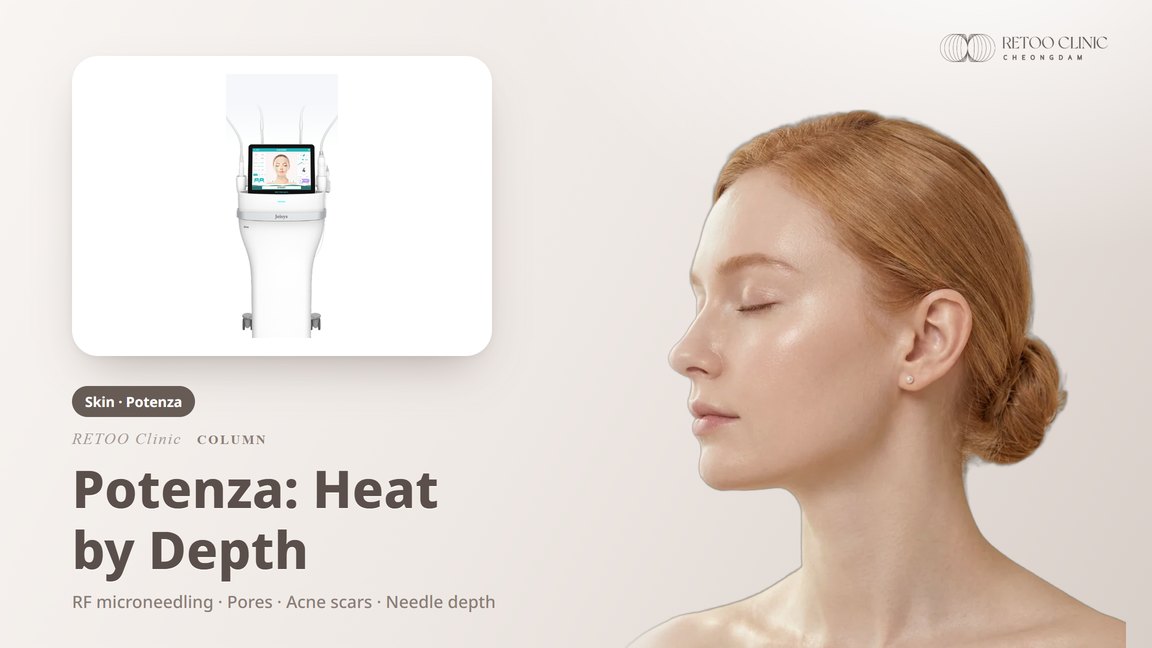
Potenza is an RF microneedling device made by Jeisys Medical. It isn't a laser; it delivers radiofrequency heat through the tips of fine needles. Medical Director Dr. Kim Jae-rim of Cheongdam RETOO Clinic explains its four modes (1MHz or 2MHz, monopolar or bipolar), needle depths of 0.5–4.0mm, how the Tiger Tip and Fusion Tip are used for pores and acne scars, and what a session and recovery involve.
Contents
- 01What is Potenza RF microneedling?
- 02How does RF microneedling work?
- 03Monopolar vs. bipolar, 1MHz vs. 2MHz: what's the difference?
- 04Tiger Tip vs. Fusion Tip: which Potenza tip is used?
- 05Does RF microneedling work for pores and acne scars?
- 06Can I fit Potenza into a trip to Seoul?
- 07Can my scars and pores be assessed from photos?
- 08How does Cheongdam RETOO Clinic use Potenza?
What is Potenza RF microneedling?
POTENZA is an RF microneedling device made by Seoul-based Jeisys Medical [1]. You'll often hear it called the "Potenza laser," but it doesn't use light. Instead, fine 0.25mm needles enter the dermis and release radiofrequency (RF) energy from their tips to coagulate tissue [1][2]. The US FDA has cleared it for electrocoagulation and hemostasis in dermatologic and general surgical procedures (510(k) K192545), and in Korea it's an approved medical device under the Ministry of Food and Drug Safety [1].
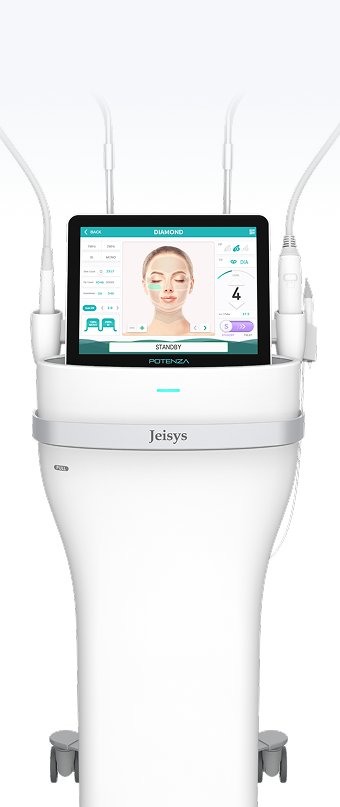
At Cheongdam RETOO Clinic, we use Potenza for enlarged pores and acne scars. As our pores page explains, RF microneedling delivers energy into the dermis or epidermis to smooth the skin. Our scar page lists it as one of several options chosen by scar type, alongside collagen-regenerating injections, PicoSure, PicoWay and PTT.
How does RF microneedling work?
The manufacturer breaks it down into three steps: the needles enter the skin, RF energy is released from the tips, and a coagulation zone forms in the surrounding dermis [1]. RF generates heat as current meets resistance in tissue, so heat is produced only at the depth the needles reach. Throughout treatment, Potenza measures skin resistance (impedance) in real time and adjusts the energy to match [1].
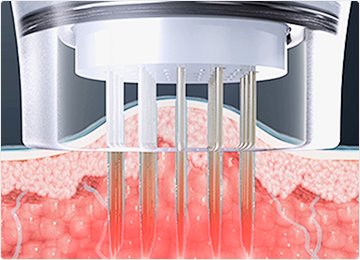
Tissue studies show what these coagulation zones do. In a 2009 study of bipolar fractional RF needles on human skin, coagulation zones formed in the dermis while the epidermis was left intact, and new collagen and elastic fibers developed at those sites [5]. A 2014 study on pig skin found that the zones took the shape of cocoon-like columns, and that their size depended more on needle depth and conduction time than on energy level [4]. In other words, how depth and timing are set is the treatment plan.
Monopolar vs. bipolar, 1MHz vs. 2MHz: what's the difference?
Potenza combines two frequencies (1MHz and 2MHz) with two delivery methods (monopolar and bipolar) for four modes in one device, and the manufacturer presents this four-mode design as a defining feature [1][2]. In monopolar mode, current flows from the needles to a grounding plate on the body, so heat spreads into deeper layers. In bipolar mode, current flows between neighboring needles, concentrating heat in the shallower layer near the tips [1][2].
| Mode | Current path | Where heat concentrates |
|---|---|---|
| Monopolar | Needle → Grounding plate | Broadly, into deeper layers |
| Bipolar | Needle ↔ Neighboring needle | Shallower layer around the tips |
| 1MHz · 2MHz | Frequency choice | Shifts heat distribution at the same depth |
Maximum output is 50W, and conduction time can be set from 5 to 500ms in 5ms steps [2]. As a general rule, depressed acne scars, where fibrous tissue deep in the dermis needs to be released and rebuilt, call for monopolar mode at depth. Sagging pores, where the upper dermis needs more firmness, call for shallow bipolar mode.
Tiger Tip vs. Fusion Tip: which Potenza tip is used?
Tips differ in needle insulation and needle count. The Tiger Tip has 16, 25 or 49 semi-insulated needles, partly coated along their length, and is designed to heat several depths in one pass at 0.5–4.0mm while sparing the epidermis [2]. Fully insulated needles (I-16, 25 and 49) heat only at the tip for extra surface protection, also reaching 0.5–4.0mm [2].
- Tiger Tip (semi-insulated 16 · 25 · 49)Depth 0.5–4.0mmSeveral depths at once · Epidermis spared
- Insulated needles (I-16 · 25 · 49)Depth 0.5–4.0mmHeat at the tip only · Deep scars
- Fusion Tip (insulated 21)Depth 0.5–2.5mmAir chambers help topicals penetrate
- Single needle (0.8 · 1.2 · 1.5mm)Point by pointActive acne · Syringoma
The Fusion Tip (pumping tip CP-21) inserts 21 insulated needles to 0.5–2.5mm, while a dual-air chamber draws air in and pushes it out to help topically applied products travel down the needle channels [2]. That's why Cheongdam RETOO Clinic considers it when pairing scar treatment with collagen-regenerating injections or skin boosters. There are also needle-free Diamond, DDR and SFA electrode tips, so the same device can deliver non-invasive treatments that heat only the surface [1].
Does RF microneedling work for pores and acne scars?
In a 2012 Korean study, 30 patients with both acne scars and enlarged pores were treated with bipolar fractional RF needles. More than 70% showed better acne scar grades and pore scores, along with smoother skin texture and higher dermal density [3]. The authors attributed the changes to regeneration of the dermal matrix; transepidermal water loss and sebum levels didn't change [3]. For the Potenza device itself, a 2026 retrospective study treated 50 melasma patients in bipolar mode, with a median of 3 sessions about 28 days apart. Modified MASI scores dropped by a median of 32.3%, and side effects occurred in 12%, all mild and gone within a week [6]. The authors note the lack of a control group as a limitation [6].
- Treatment dayAbout 1 hour including numbing cream · Redness fades within 2–4 hours
- Between sessionsNeedle depth and mode adjusted to your skin's response
- Around 3 sessionsMedian of 3 in the 2026 study · Your number is set at consultation
According to the manufacturer's FAQ, the whole visit takes about an hour, from numbing cream to post-treatment care, and redness usually fades within 2–4 hours [1]. Afterwards, wear sunscreen and drink plenty of water. The number of sessions is decided at your consultation, based on your skin [1].
Can I fit Potenza into a trip to Seoul?
If you're visiting Seoul from abroad, plan around the recovery details in the manufacturer's FAQ. A session takes about an hour from numbing cream to post-treatment care, and redness usually fades within 2–4 hours [1]. Afterwards, wear sunscreen and stay hydrated [1]. If you're planning an afternoon outdoors in strong sun, keep those few hours of redness and the need for sun protection in mind.
Acne scars and enlarged pores are usually treated over several sessions, with needle depth and mode adjusted based on how your skin responded last time. The 2026 study used a median of 3 sessions about 28 days apart [6], but that's a study figure, not a schedule set for you in advance. How many sessions you need, how far apart and how long to stay are decided at your consultation, based on your scars, your pores and your skin's response.
Can my scars and pores be assessed from photos?
Photos sent before your visit are a good way to show where your scars or pores bother you and what kind of change you're hoping for. But the decisions that shape a Potenza plan depend on distinctions that are hard to make from a photo: whether a scar is depressed or is a red mark or pigmentation, and whether pores are enlarged from sagging or from excess oil. These are confirmed with skin measurement at your in-person consultation, and the mode, depth and tip are chosen from there. Please send photos of the areas of concern only, and never photos of ID documents.
Likewise, the cost of Potenza depends on the areas treated, the tip used, the number of sessions and whether it's combined with collagen-regenerating injections or pico lasers, so your final plan is explained after your in-person consultation.
How does Cheongdam RETOO Clinic use Potenza?
At Cheongdam RETOO Clinic, we don't rely on a single device for pores and scars. Enlarged pores have many causes, including excess oil, loss of firmness and coarser hair, so we choose between tightening, sebaceous gland treatment, collagen stimulation and RF depending on whether sagging or oil-enlarged pores are the bigger issue. Scars are sorted first, too: depressed scars on one side, pigmentation and red marks on the other. Red marks and pigmentation are treated with vascular and pico lasers.
- 01Skin measurementDepressed scars · Sagging pores · Red marks · Pigmentation assessed separately
- 02Mode and depth planningDeep scars: monopolar, deep · Pores: bipolar, shallow
- 03Tip selectionTiger Tip · Insulated needles · Fusion Tip when adding topicals
- 04Combining and next sessionSequenced with collagen-regenerating injections and pico lasers · Adjusted to your skin's
Questions for your Potenza consultation
- Are my scars depressed, or are they red marks and pigmentation?
- Are my pores enlarged from sagging or from oil?
- Should we go deep with monopolar or shallow with bipolar?
- Would the Fusion Tip with topicals help in my case?
- Can I fit 2–4 hours of redness into my schedule?
For depressed scars, we consider heating the fibrous tissue deep in the dermis with Potenza, then filling with collagen-regenerating injections. For surface texture and sagging pores, we first consider OPUS RF Pixel or shallow bipolar mode. At Cheongdam RETOO Clinic, needle depth and conduction time are adjusted at every session based on how your skin responded to the last one.
Frequently asked questions
Is Potenza a laser?
No. Potenza is an RF microneedling device: fine needles enter the dermis and release radiofrequency (RF) heat from their tips. It works differently from pico lasers, which use light, so Cheongdam RETOO Clinic uses Potenza for depressed scars and pores, and lasers for red marks and pigmentation.
Does Potenza hurt, and how long is recovery?
Numbing cream is applied first, and according to the manufacturer the visit takes about an hour from numbing cream to post-treatment care. Redness usually fades within 2–4 hours. Afterwards, wear sunscreen and drink plenty of water.
How many Potenza sessions will I need?
That's decided at your consultation, based on scar depth and pore condition. The 2026 study of Potenza for melasma used a median of 3 sessions about 4 weeks apart, and Cheongdam RETOO Clinic adjusts needle depth and mode at each session based on your skin's response.
Can I start Potenza during a short visit to Seoul?
A session takes about an hour, and redness usually fades within 2–4 hours. Scars and pores are generally treated over several sessions, so the number and spacing of sessions, and how they fit your travel plans, are decided at your consultation after an in-person skin assessment.
Related treatments
References
- Jeisys Medical Inc. POTENZA – RF microneedling: principle (coagulation zone), impedance check, 1/2MHz monopolar·bipolar, tips, FAQ. Official website
- Cynosure LLC. Potenza Physician Brochure – specifications, Tiger Tip, Fusion Tip, insulated and single needles. 2021 (PDF)
- Cho SI, Chung BY, Choi MG, Baek JH, Cho HJ, Park CW, Lee CH, Kim HO. Evaluation of the clinical efficacy of fractional radiofrequency microneedle treatment in acne scars and large facial pores. Dermatol Surg. 2012;38(7 Pt 1):1017-1024. doi:10.1111/j.1524-4725.2012.02402.x
- Zheng Z, Goo B, Kim DY, Kang JS, Cho SB. Histometric analysis of skin-radiofrequency interaction using a fractionated microneedle delivery system. Dermatol Surg. 2014;40(2):134-141. doi:10.1111/dsu.12411
- Hantash BM, Ubeid AA, Chang H, Kafi R, Renton B. Bipolar fractional radiofrequency treatment induces neoelastogenesis and neocollagenesis. Lasers Surg Med. 2009;41(1):1-9. doi:10.1002/lsm.20731
- Kim HB, Lee SY, Um JY, Baek SY, Kim HO, Kumar N. Clinical effects and safety of radiofrequency microneedling for the management of melasma: a retrospective study. Aesthet Surg J Open Forum. 2026;8:ojag143. doi:10.1093/asjof/ojag143
Planning a consultation in Seoul?
Send us your questions about this treatment. Our team will get back to you as soon as we see your message.
How to book a consultation
- 01Send us a message
Message us on WhatsApp or LINE. Tell us which treatment or concern you are interested in and when you plan to be in Seoul.
- 02Share photos if you wish
Photos of the area of concern only (no ID documents) help us talk about the general direction. The treatment plan itself is decided at the in-person consultation.
- 03Choose a consultation time
Our team suggests available dates and times, and your booking is confirmed once you choose one.
- 04In-person consultation
At the clinic, the doctor examines your skin and explains the treatment plan, recovery and cost before any treatment.
- 05Treatment and aftercare
After the treatment, we explain how to care for your skin, including what to keep in mind for your trip home.
Clinic Hours Weekdays 10:00–19:00 · Thu 10:00–21:00 · Sat 10:00–16:30 · Closed on Sundays and public holidays
Address 5–6F, First Light Tower, 417 Dosan-daero, Gangnam-gu, Seoul · 500m walk from Exit 4, Apgujeongrodeo Station (Bundang Line), across from the Mercedes-Benz Cheongdam Showroom · Hours & Location