





Column
Hyperbaric Oxygen Therapy in Seoul: Why Oxygen Helps After Treatment
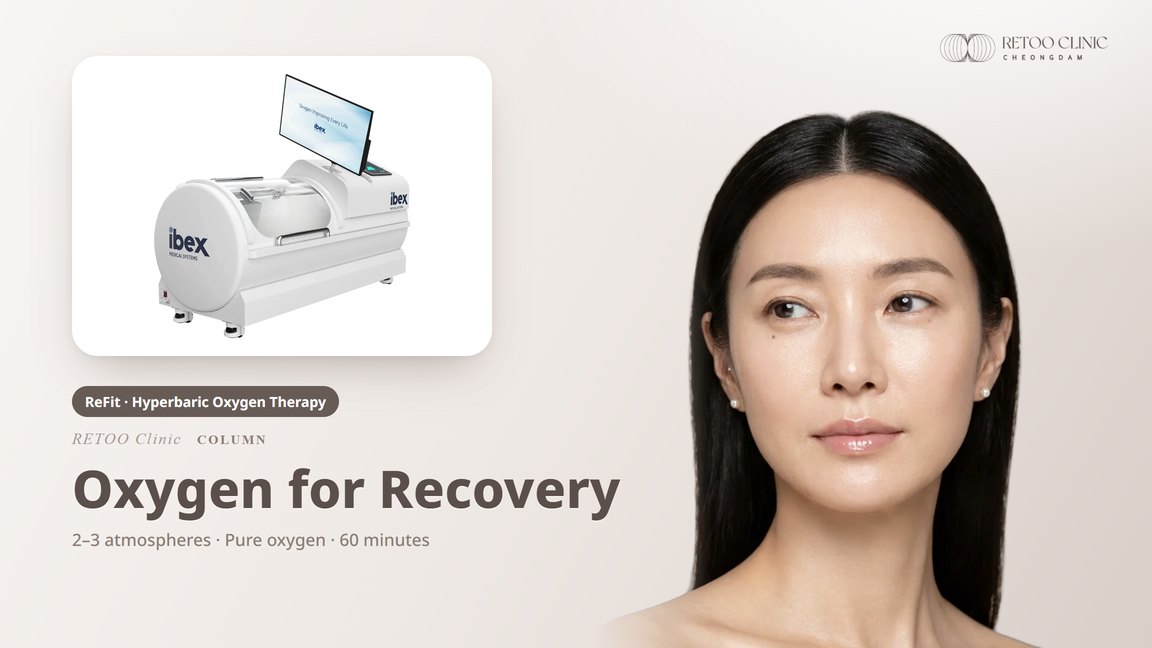
Hyperbaric oxygen therapy (HBOT) means breathing medical-grade pure oxygen for 60 minutes in a chamber pressurized to 2–3 atmospheres. More oxygen dissolves into the plasma and reaches tissue beyond damaged blood vessels, giving collagen-making fibroblasts and new blood vessels what they need. Cheongdam RETOO Clinic explains why we use an IBEX chamber after lifting lasers and skin boosters, what a session is like, and who shouldn't have it.
Contents
- 01What is hyperbaric oxygen therapy (HBOT)?
- 02How does extra oxygen help your skin heal?
- 03Why use HBOT after lifting and skin booster treatments?
- 04What happens during an HBOT session?
- 05Is HBOT safe? Who shouldn't have it?
- 06Adding HBOT to your treatment plan on a trip to Seoul
- 07How does Cheongdam RETOO Clinic use HBOT?
What is hyperbaric oxygen therapy (HBOT)?
Hyperbaric oxygen therapy (HBOT) involves breathing medical-grade pure oxygen inside a sealed chamber where the pressure is raised to 2–3 atmospheres, above normal air pressure. At Cheongdam RETOO Clinic, we use this environment to raise oxygen levels in the plasma to 10–15 times their usual level, supporting tissue repair, calming inflammation and helping you recover after treatment. Each session centers on 60 minutes of breathing oxygen.
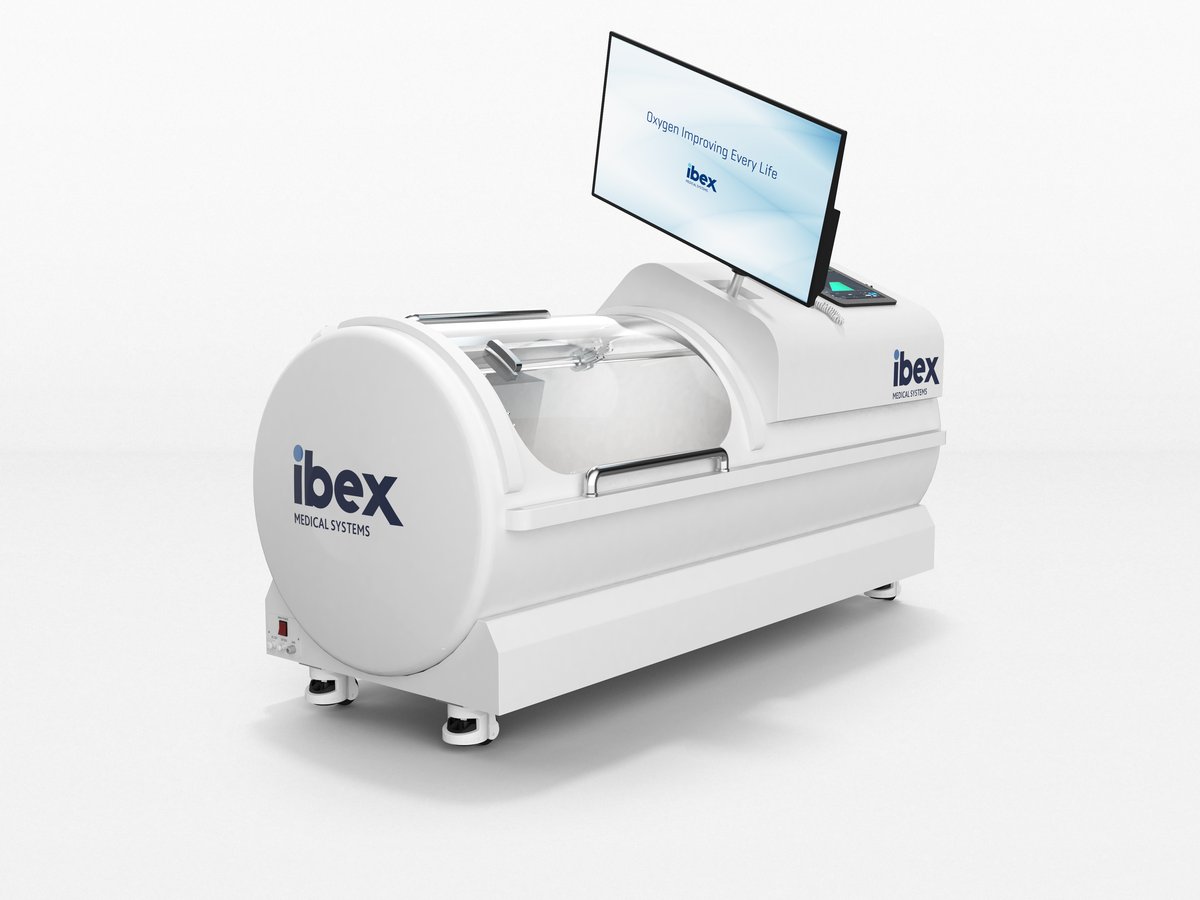
Our chamber is a monoplace (single-person) hyperbaric chamber made by the Korean manufacturer IBEX Medical Systems. The IBEX M2 can be pressurized up to 3 atmospheres (3 ATA). It's built to ASME PVHO-1, the design standard for pressure vessels for human occupancy, and NFPA 99, the standard for medical gas systems, and it carries European CE certification [2]. In 2025, the manufacturer also obtained ASME U/U2/PVHO-1 and CE PED certification [1]. The chamber pressurizes and depressurizes automatically, stores treatment records, and has an intercom so you can talk with the medical team throughout [2].
- Most oxygen is carried by hemoglobin in red blood cells
- Much more oxygen dissolves in the plasma and reaches tissue without hemoglobin
How does extra oxygen help your skin heal?
When you breathe normally, most oxygen reaches your tissues bound to hemoglobin in red blood cells. Breathe pure oxygen under pressure, and far more oxygen dissolves directly into the plasma (the liquid part of your blood), letting it diffuse into areas hemoglobin can't reach [3]. Where blood vessels are damaged by a wound or swelling, circulation is disrupted and the tissue runs short of oxygen. Hyperbaric oxygen eases that shortage by letting oxygen seep directly into tissue outside the vessels.
- 01Healthy blood vesselsHealthy vessels deliver oxygen throughout the tissue
- 02Damaged blood vesselsA wound or swelling disrupts circulation and the tissue runs short of oxygen
- 03Breathing oxygen under pressureConcentrated oxygen seeps directly into tissue outside the vessels
- 04RecoveryNew blood vessels form and damaged tissue is repaired
Three things change once oxygen reaches the tissue. First, oxygen is an essential ingredient for collagen synthesis and new blood vessel formation during healing, and HBOT supports this by raising oxygen partial pressure (the pressure of oxygen within the tissue) in tissue that was oxygen-starved [3]. Second, blood vessels constrict, so less fluid leaks into the tissue and swelling goes down [3]. Third, cells respond: when human skin fibroblasts (the cells that make collagen) were exposed to hyperbaric oxygen at 2 atmospheres for 90 minutes a day, cell growth increased by day 7, with an early rise in the growth factor bFGF [4]. Separately, CD34+ stem and progenitor cells in the blood roughly doubled after a single HBOT session and rose about eightfold after 20 sessions [5].
Why use HBOT after lifting and skin booster treatments?
Lifting lasers and skin boosters work by creating tiny controlled injuries in the skin with heat or needles; new collagen forms as those injuries heal. What shapes your result is the stage after that: heated collagen contracts, then fibroblasts spend several weeks building new collagen. Oxygen is a key raw material for that work [3]. At Cheongdam RETOO Clinic, we use HBOT to set up the right conditions for recovery, so that freshly treated, sensitive skin doesn't have to rely on natural healing alone.
| After treatment | How HBOT helps |
|---|---|
| Needle marks · Bumps (raised marks after a skin booster) | Helps skin settle faster and shortens downtime |
| Inflammation · Swelling | Calms inflammation and brings swelling down faster |
| Bruising | Helps clear what has leaked out of the vessels |
| Collagen remodeling | Supplies oxygen to fibroblasts so results can settle in |
Combined with stem cell treatments, it helps support the number and activity of the cells. To be clear, though, HBOT doesn't replace your treatment. It's a recovery step that helps the changes your treatment started to settle in.
What happens during an HBOT session?
Once you're inside the chamber, the pressure is raised gradually. Your ears will feel blocked, much like on a plane during takeoff; you can clear them by swallowing, yawning or using the Valsalva maneuver (pinching your nose and gently breathing out). Once the target pressure is reached, you relax and breathe concentrated oxygen for 60 minutes, and you're welcome to nap. The pressure is then slowly brought back to normal. Keep breathing normally during this phase without holding your breath, and the team will let you know when it's time to step out.
- 01Step inYou enter the chamber
- 02PressurizationPressure rises gradually · Clear your ears by swallowing, yawning or the Valsalva maneuver
- 0360 minutes of oxygenBreathe concentrated oxygen at the set pressure · Feel free to nap
- 04DepressurizationPressure slowly returns to normal · Don't hold your breath
- 05Step outLeave when the team gives the all-clear

Is HBOT safe? Who shouldn't have it?
The most common side effect of HBOT is middle-ear barotrauma, which happens when you can't equalize ear pressure during pressurization. Others include sinus pain, anxiety in an enclosed space and temporary shifts toward nearsightedness; oxygen toxicity seizures are rare [6]. So if you have a bad head cold that makes it hard to clear your ears, claustrophobia, a chronic lung condition such as pneumothorax or asthma, a heart condition such as bradycardia or tachycardia, a history of glaucoma or cataract surgery, recent ear, nose and throat surgery, or a history of epilepsy or seizures, talk to the specialist before treatment.
Before your session
- Bad head cold · Recent ear, nose and throat surgery (ear equalization)
- Claustrophobia
- Chronic lung conditions such as pneumothorax or asthma
- Heart conditions such as bradycardia or tachycardia
- History of glaucoma or cataract surgery · History of epilepsy or seizures
- No phones, cigarettes, lighters, batteries or other items that could cause fire or static
Because the chamber holds a high concentration of oxygen, anything that could spark a fire or static electricity has to stay outside. If your ears hurt during treatment, tell the team over the intercom right away; they'll pause pressurization and help you equalize again.
Adding HBOT to your treatment plan on a trip to Seoul
If you're coming to Seoul for a lifting laser or skin booster, it helps to know how HBOT fits around your treatment. When the goal is to calm sensitive skin right after a lifting laser or skin booster, HBOT follows on the same day. Allow for the 60 minutes of oxygen plus time for pressurization and depressurization, and remember that phones, batteries and anything else that could cause fire or static can't come into the chamber with you.
Before you travel, look through the checklist above. A bad head cold, recent ear, nose and throat surgery, claustrophobia, lung or heart conditions, a history of glaucoma or cataract surgery, or a history of epilepsy or seizures should be raised before treatment so the specialist can review it first. If you catch a cold during your trip, mention it before your session too.
How many sessions to add, and after which treatment, depends on the treatment and how you're recovering, so your length of stay and number of visits are planned at your consultation.
How does Cheongdam RETOO Clinic use HBOT?
At Cheongdam RETOO Clinic, HBOT isn't a stand-alone add-on; it's the final step of our "Result Completion Process." After treatments that trigger a healing response in the skin, such as heat-based lifting with Ultherapy Prime or Thermage FLX, or skin boosters, we schedule chamber time so that response can run its course without an oxygen shortfall. How many sessions you'll have after which treatment is decided at your consultation, based on the treatment and how you're recovering.
If you're considering a treatment, add this question to your consultation: "How will you support my recovery afterwards?"
Frequently asked questions
Is HBOT done on the same day as my treatment?
When the goal is to calm sensitive skin right after a lifting laser or skin booster, yes, it follows on the same day. How many sessions to add is decided at your consultation, based on the treatment and how you're recovering.
What if my ears hurt in the chamber?
If your ears feel blocked during pressurization, clear them by swallowing, yawning or using the Valsalva maneuver. If they still hurt, tell the team over the intercom; they'll pause pressurization and help you equalize again. If you have a bad head cold, let us know before your session.
How long does an HBOT session take?
Sixty minutes of breathing oxygen at the set pressure, plus time for pressurization and depressurization. You're welcome to nap during the oxygen phase. Phones, batteries and other items that could cause fire or static can't be taken inside.
I'm only in Seoul for a short visit. Can I add HBOT to my treatment?
Yes, it can follow a lifting laser or skin booster on the same day. Please mention any cold, recent ear, nose and throat surgery, or other conditions on the checklist before your session. How many sessions to add is decided at your consultation, based on your treatment and recovery.
Related treatments
References
- IBEX Medical Systems. Company history — ISO 13485 · CE (MDD) · ASME U/U2/PVHO-1 · CE PED certifications. Official website
- IBEX Medical Systems. IBEX M2 monoplace hyperbaric oxygen chamber specifications (up to 3 ATA · ASME PVHO-1 · NFPA 99 · CE · automatic control · intercom). Manufacturer's registered product page
- Thom SR. Hyperbaric oxygen: its mechanisms and efficacy. Plast Reconstr Surg. 2011;127(Suppl 1):131S-141S. doi:10.1097/PRS.0b013e3181fbe2bf
- Kang TS, Gorti GK, Quan SY, Ho M, Koch RJ. Effect of hyperbaric oxygen on the growth factor profile of fibroblasts. Arch Facial Plast Surg. 2004;6(1):31-35. doi:10.1001/archfaci.6.1.31
- Thom SR, Bhopale VM, Velazquez OC, Goldstein LJ, Thom LH, Buerk DG. Stem cell mobilization by hyperbaric oxygen. Am J Physiol Heart Circ Physiol. 2006;290(4):H1378-H1386. doi:10.1152/ajpheart.00888.2005
- Heyboer M 3rd, Sharma D, Santiago W, McCulloch N. Hyperbaric oxygen therapy: side effects defined and quantified. Adv Wound Care (New Rochelle). 2017;6(6):210-224. doi:10.1089/wound.2016.0718
Planning a consultation in Seoul?
Send us your questions about this treatment. Our team will get back to you as soon as we see your message.
How to book a consultation
- 01Send us a message
Message us on WhatsApp or LINE. Tell us which treatment or concern you are interested in and when you plan to be in Seoul.
- 02Share photos if you wish
Photos of the area of concern only (no ID documents) help us talk about the general direction. The treatment plan itself is decided at the in-person consultation.
- 03Choose a consultation time
Our team suggests available dates and times, and your booking is confirmed once you choose one.
- 04In-person consultation
At the clinic, the doctor examines your skin and explains the treatment plan, recovery and cost before any treatment.
- 05Treatment and aftercare
After the treatment, we explain how to care for your skin, including what to keep in mind for your trip home.
Clinic Hours Weekdays 10:00–19:00 · Thu 10:00–21:00 · Sat 10:00–16:30 · Closed on Sundays and public holidays
Address 5–6F, First Light Tower, 417 Dosan-daero, Gangnam-gu, Seoul · 500m walk from Exit 4, Apgujeongrodeo Station (Bundang Line), across from the Mercedes-Benz Cheongdam Showroom · Hours & Location