





Column
CORAGE 2.0 in Seoul: How 16-Frequency QMR Differs from Standard RF
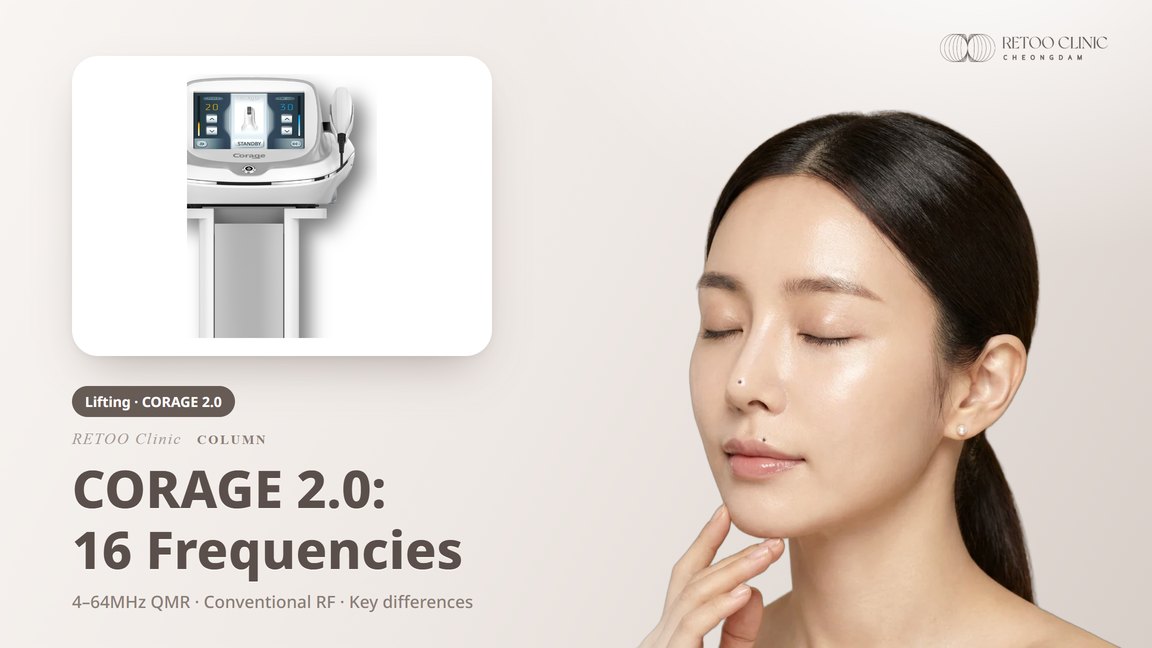
CORAGE 2.0 (Corage Cellfit) is a Korean device made by QuanteQ using QMR (Quantum Molecular Resonance) technology from Italy's Telea. It delivers 16 frequencies between 4 and 64MHz at once to set ions and molecules in the skin in motion. Medical Director Dr. Kim Jae-rim of Cheongdam RETOO Clinic explains how it differs from conventional RF, how the four handpieces are chosen, and what a session and recovery are like.
Contents
- 01What is CORAGE 2.0?
- 02What is QMR, and what does it do in the skin?
- 03CORAGE vs. Thermage: how is it different from standard RF?
- 04What do the four CORAGE 2.0 handpieces do?
- 05Does CORAGE 2.0 hurt, and is there downtime?
- 06Can I fit CORAGE 2.0 into a short trip to Seoul?
- 07How does Cheongdam RETOO Clinic use CORAGE 2.0?
What is CORAGE 2.0?
CORAGE is a Korean-made device launched in 2017 by QuanteQ Co., Ltd., following a 2016 technology partnership with Telea Electronic Engineering of Italy [1]. The 2021 version, which added a vacuum-suction Egg handpiece, is CORAGE 2.0; the manufacturer also calls it Corage Cellfit [3]. So when you see "CORAGE CELLFIT" and "CORAGE 2.0" on our pages, they're two official names for the same device.
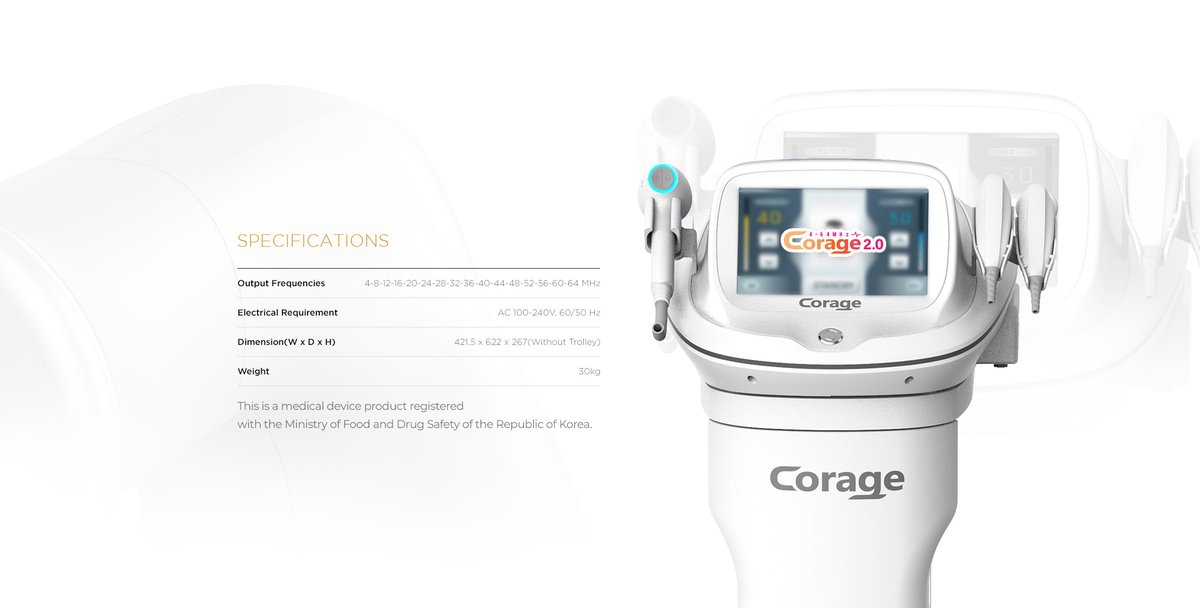
In Korea, it's approved by the Ministry of Food and Drug Safety (MFDS) as a general-purpose electrosurgical unit, a category of device that uses radiofrequency current to coagulate tissue or relieve pain [4]. At Cheongdam RETOO Clinic, we use it for patients whose skin feels sensitized after frequent laser treatments, and for those who want to care for their facial contours and firmness with a gentler, low-discomfort option rather than injectables or treatments that use heat to create micro-injuries.
What is QMR, and what does it do in the skin?
QMR (Quantum Molecular Resonance) is a technology patented by Telea. Starting from a 4MHz base frequency, it delivers 16 frequencies at 4MHz steps (8, 12, 16 and on up to 64MHz) all at once [2][5]. When this electric field reaches the skin and its cells, charged particles (ions) oscillate back and forth, polar molecules rotate, and that motion is converted into biological heat within the tissue [2]. A frequency of 64MHz means 64 million oscillations per second, which is where the line on our CORAGE page, "up to 64 million movements per second," comes from [1].
The manufacturer describes QMR as technology that "induces cellular motion while helping cells regenerate," and notes that the same resonance technology is used for wound care in Europe [1]. In a lab study, human bone-marrow mesenchymal stem cells were exposed to QMR for 10 minutes a day over 4 days, in two cycles. Their viability, proliferation and ability to differentiate were the same as in the control group, while expression of MMP1 and PLAT, genes involved in tissue remodeling, went up [5]. That's the core idea: a stimulus that changes how cells behave without destroying them.
CORAGE vs. Thermage: how is it different from standard RF?
Conventional radiofrequency, such as Thermage, runs current at a single frequency through tissue to create resistive heat. That heat contracts collagen, and new collagen grows in afterwards. CORAGE works differently: instead of turning up the current, it layers frequencies. A low-intensity alternating field is delivered across 16 frequencies to set molecules in motion, without aiming for heat that burns tissue or creates wounds [2][5].
| Feature | Conventional RF | CORAGE 2.0 (QMR) |
|---|---|---|
| Frequency | One | 16 at once, from 4 to 64MHz |
| How heat is produced | Resistive heat from current | Ion and molecular motion becomes biological heat |
| Effect on tissue | Heat to contract collagen | Stimulus aimed at cellular motion and recovery |
| Features cited by the manufacturer | — | Little downtime · Low discomfort · Lunch-break treatment |
That's why our CORAGE page describes it as "not a lifting treatment that injects foreign substances into the skin or creates wounds with heat to induce regeneration, but one that wakes up the cells sleeping inside your own skin." Since it doesn't tighten by heating hard, Cheongdam RETOO Clinic often uses it to let skin recover after heat-based lifting like Thermage or Ultherapy, or to boost skin condition between those sessions.
What do the four CORAGE 2.0 handpieces do?
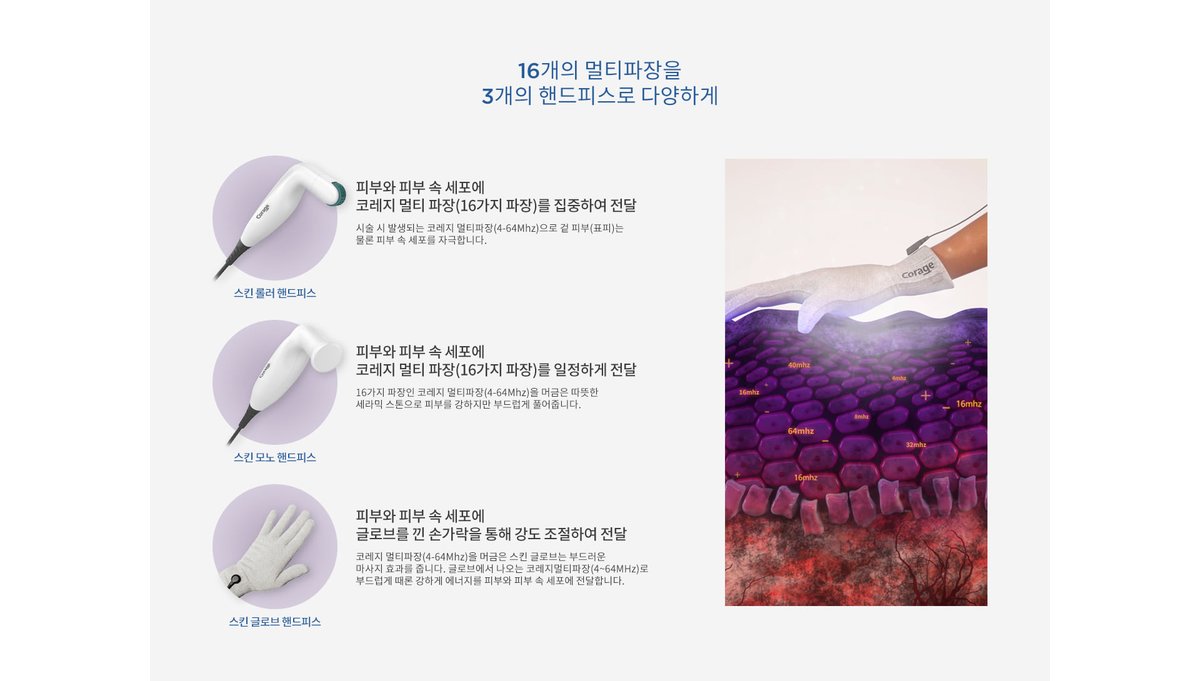
CORAGE 2.0 delivers the same 16 frequencies through four different handpieces [4]. The skin roller glides across the skin to focus stimulation on the epidermis and the cells beneath it. The skin mono uses a warm ceramic stone charged with the frequencies to work the skin firmly but gently. The skin glove lets the provider deliver energy through gloved fingertips, massage-style, adjusting intensity by touch [2]. The Egg (suction) handpiece, added in 2021, uses gentle vacuum to draw the skin up into close contact and send the frequencies down to the dermis and its cells [3].
- Egg (suction)Vacuum draws skin into close contactReaches the dermis · Added in 2021
- Skin rollerRolled to focus on the epidermis and cells beneathLarger areas of the face
- Skin monoEven delivery with a warm ceramic stoneFirm yet gentle
- Skin gloveIntensity adjusted by fingertipMassage-style · Delicate areas
The main unit's maximum output is 50W [2]. The device doesn't decide which handpiece to use, in what order or at what intensity. That's why our CORAGE page notes that "there are many factors the practitioner must decide, such as treatment intensity, method and the amount of energy." Cheongdam RETOO Clinic uses only genuine tips and adjusts the handpiece combination to each skin type.
Does CORAGE 2.0 hurt, and is there downtime?
The manufacturer highlights little downtime, sessions short enough for a lunch break, and low discomfort as CORAGE 2.0's key features [3]. There are no needles and no thermal coagulation points; a ceramic stone, roller or glove simply moves over the skin. Most people don't need numbing cream and go straight back to their day. How much discomfort or redness you feel varies from person to person.
- 01Skin assessmentSkin type · Sensitivity · Facial contours
- 02Handpiece and intensity setupMix of Egg · Roller · Mono · Glove and output level
- 03TreatmentShort enough for a lunch break
- 04Back to your dayAlmost no downtime · Cleansing and makeup OK
There's also a published case report using CORAGE 2.0 itself. Two women with melasma on the cheekbones had five 15-minute sessions, two weeks apart, with a ceramic handpiece set to 35W and 4–64MHz. Their melasma scores (MASI) dropped from 4.8 to 2.4 and from 12 to 9 [6]. With just two patients and no control group, it doesn't tell us how large the effect is, but it does show how the device is typically used: 15-minute sessions every two weeks. The manufacturer hasn't published official figures on how many sessions you need or how long results last, so Cheongdam RETOO Clinic sets your next interval based on how your skin responds to the first session.
Can I fit CORAGE 2.0 into a short trip to Seoul?
If you're visiting Seoul from abroad, the manufacturer's points are what matter: little downtime, a session that fits into a lunch break, and low discomfort [3]. Most people skip numbing cream and can cleanse and wear makeup right after, so you usually don't need to block out recovery time in your itinerary. Discomfort and redness still vary from person to person.
What can't be settled in advance is how many sessions you'll need. The manufacturer has no official number, and we set your next interval after seeing how your skin responds to the first one. If you're also considering heat-based lifting like Thermage or Ultherapy on the same trip, we plan the order and spacing together. How many visits make sense and how long to stay are decided at your consultation, based on your treatments and how your skin responds.
Photos sent before your visit are a good way to show what bothers you and the general direction you have in mind. Whether your main concern is skin condition or sagging, and which handpieces suit your skin, are decided at your in-person skin assessment. Please send photos of the areas of concern only, and never photos of ID documents.
How does Cheongdam RETOO Clinic use CORAGE 2.0?
At Cheongdam RETOO Clinic, we don't see CORAGE 2.0 as a replacement for heat-based lifting; we see it as a way to improve the condition of the skin itself. After assessing your age, face shape, skin condition, facial bone structure, and fat and muscle, we put heat-based lifting such as Thermage, Ultherapy or Sofwave first when sagging is the main concern. CORAGE comes first for skin sensitized by frequent laser treatments, or for patients who want to care for texture and firmness with a low-discomfort option.
Questions for your CORAGE 2.0 consultati
- Is my main concern skin condition or sagging?
- Which of the four handpieces will be used, and where?
- Should I have it alongside heat-based lifting or between sessions?
- How long does a session take, and does it fit my schedule that day?
- How will my next interval be decided after the first session?
As our CORAGE page puts it, this is a device with many variables for the practitioner to decide. Drawing on clinical experience with CORAGE 2.0, Cheongdam RETOO Clinic tailors the handpiece combination and intensity to each skin type, and when it's paired with heat-based lifting, we plan the order and spacing of both together.
Frequently asked questions
Is CORAGE 2.0 the same as RF lifting like Thermage?
Both use radiofrequency energy, but differently. Thermage uses current at a single frequency to create resistive heat that contracts collagen, while CORAGE delivers 16 frequencies from 4 to 64MHz at once to set ions and molecules in the skin in motion. Cheongdam RETOO Clinic considers heat-based lifting first for sagging, and CORAGE first for overall skin condition and sensitized skin.
Does CORAGE 2.0 hurt? Do I need numbing?
Since a ceramic stone, roller, glove or suction handpiece simply moves over the skin, the manufacturer highlights low discomfort and little downtime. Most people don't need numbing cream, and you can cleanse and wear makeup right after.
How many CORAGE 2.0 sessions will I need?
The manufacturer has no official number. In the CORAGE 2.0 case report, patients had five 15-minute sessions two weeks apart. Cheongdam RETOO Clinic sets your next interval based on how your skin responds to the first session and any other treatments you're having.
Can I have CORAGE 2.0 during a short trip to Seoul?
The manufacturer describes little downtime and a session short enough for a lunch break, and most people go straight back to their day. The number of sessions and their spacing aren't set in advance; they're decided at your consultation after seeing your skin's response and any other treatments planned for the same trip.
Related treatments
References
- QuanteQ Co., Ltd. Core technology – QMR technology (16 resonant frequencies · cellular motion · wound care in Europe). Official website
- QuanteQ Co., Ltd. Corage Cellfit product information – Corage multi-frequency 4–64MHz, 16 frequencies · skin roller / mono / glove handpieces · specifications. Official website
- QuanteQ Co., Ltd. New Corage 2.0 – Corage Egg hand-piece (2021), Advantages of New Corage. Official English website
- QuanteQ Co., Ltd. Corage 2.0 official website – four handpiece modes · scope of approval by Korea's Ministry of Food and Drug Safety (general-purpose electrosurgical unit)
- Sella S, Adami V, Amati E, et al. In-vitro analysis of Quantum Molecular Resonance effects on human mesenchymal stromal cells. PLoS One. 2018;13(1):e0190082. doi:10.1371/journal.pone.0190082
- Cho E, Kim MH. Amelioration of Melasma Using Quantum Molecular Resonance. J Cosmet Dermatol. 2025;24(2):e16701. doi:10.1111/jocd.16701
Planning a consultation in Seoul?
Send us your questions about this treatment. Our team will get back to you as soon as we see your message.
How to book a consultation
- 01Send us a message
Message us on WhatsApp or LINE. Tell us which treatment or concern you are interested in and when you plan to be in Seoul.
- 02Share photos if you wish
Photos of the area of concern only (no ID documents) help us talk about the general direction. The treatment plan itself is decided at the in-person consultation.
- 03Choose a consultation time
Our team suggests available dates and times, and your booking is confirmed once you choose one.
- 04In-person consultation
At the clinic, the doctor examines your skin and explains the treatment plan, recovery and cost before any treatment.
- 05Treatment and aftercare
After the treatment, we explain how to care for your skin, including what to keep in mind for your trip home.
Clinic Hours Weekdays 10:00–19:00 · Thu 10:00–21:00 · Sat 10:00–16:30 · Closed on Sundays and public holidays
Address 5–6F, First Light Tower, 417 Dosan-daero, Gangnam-gu, Seoul · 500m walk from Exit 4, Apgujeongrodeo Station (Bundang Line), across from the Mercedes-Benz Cheongdam Showroom · Hours & Location