





Column
When Will I See Thermage FLX Results? A Timeline from a Seoul Clinic
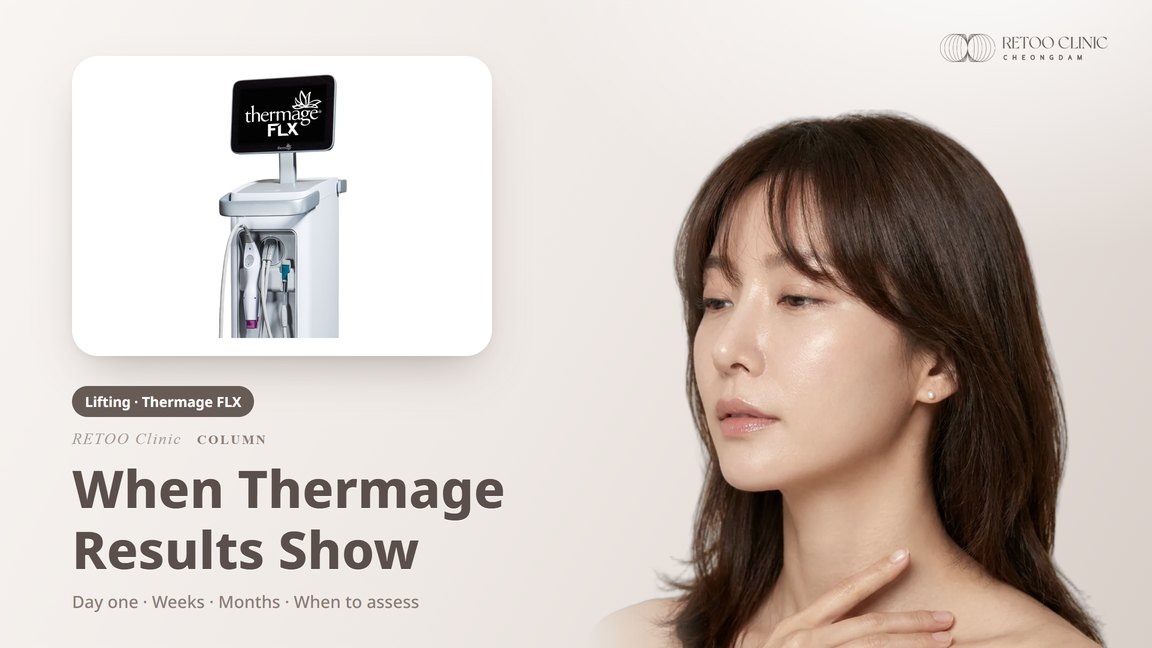
Right after Thermage FLX, dermal collagen contracts and the skin feels tighter; over the next 2–6 months, new collagen forms and the results keep building. Cheongdam RETOO Clinic explains what changes on day one, over weeks and over months, how to track your results, and how we assess them.
Contents
- 01Do you see Thermage results right away?
- 02What happens right after Thermage?
- 03Why do Thermage results keep improving for 2–6 months?
- 04Thermage results seem slow. Did I get enough shots?
- 05How long do Thermage results last, and when should I check in?
- 06Timing Thermage FLX around a trip to Seoul
- 07Can I track my progress with photos from home?
- 08How does Cheongdam RETOO Clinic assess Thermage results?
Do you see Thermage results right away?
Thermage FLX results come in two stages. As soon as heat reaches the dermis, collagen denatures [3]. Then comes remodeling, as new collagen forms over 2–6 months [2]. The manufacturer notes that some patients feel immediate tightening, with improvement continuing for up to 6 months [2].
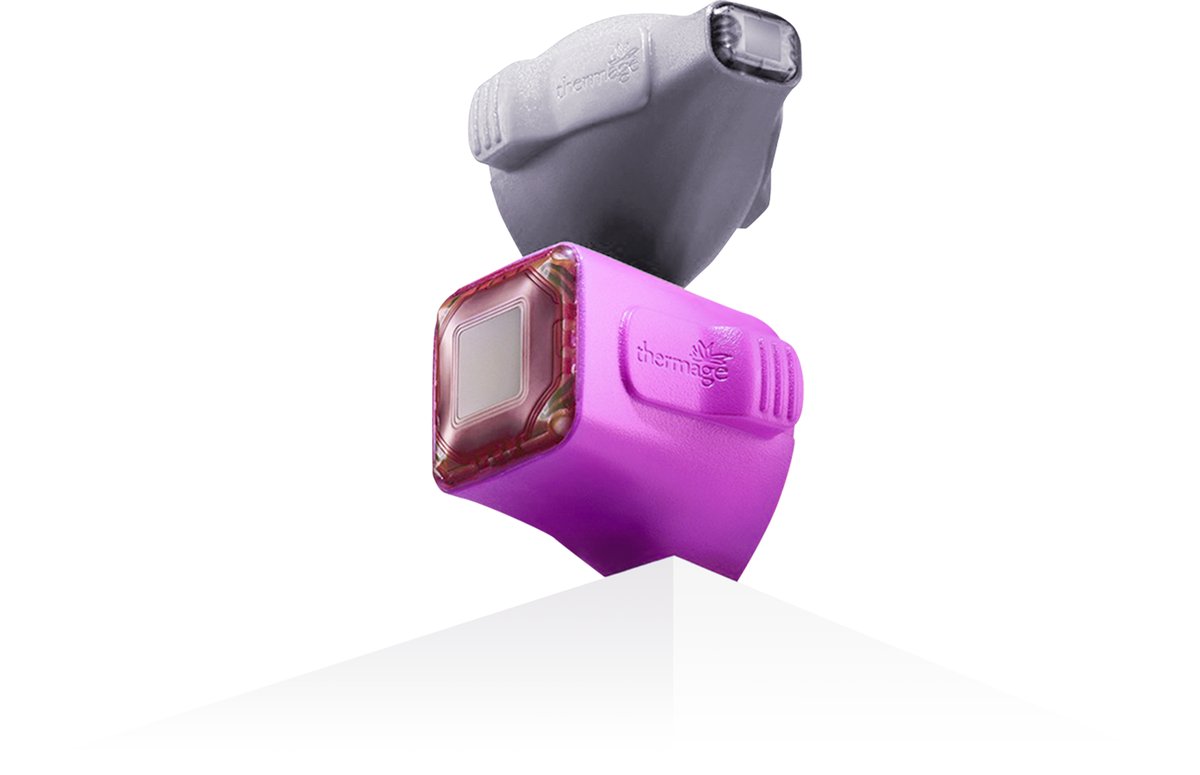
Thermage FLX is a fourth-generation monopolar radiofrequency device. A rapidly alternating current runs between the tip on your skin and a grounding pad on your body, and the tissue's resistance turns that current into heat. Its core principle is what the manufacturer calls the Reverse Thermal Gradient: a cooling system protects the surface while heat reaches deep into the dermis [1].
Heated dermal collagen denatures and the skin contracts, along with the fibrous septae that run through the fat layer [3]. Next, that collagen is rebuilt, which is what improves wrinkles [3]. So if you don't see much difference a few days later, that doesn't mean it hasn't worked. And the tightness you feel on day one isn't the final result.
What happens right after Thermage?
Your skin will feel firmer straight away, usually with some temporary redness or mild swelling. Redness typically fades within 24 hours and swelling within a few days [2]. Because of that redness, photos taken on the day don't give an accurate picture.
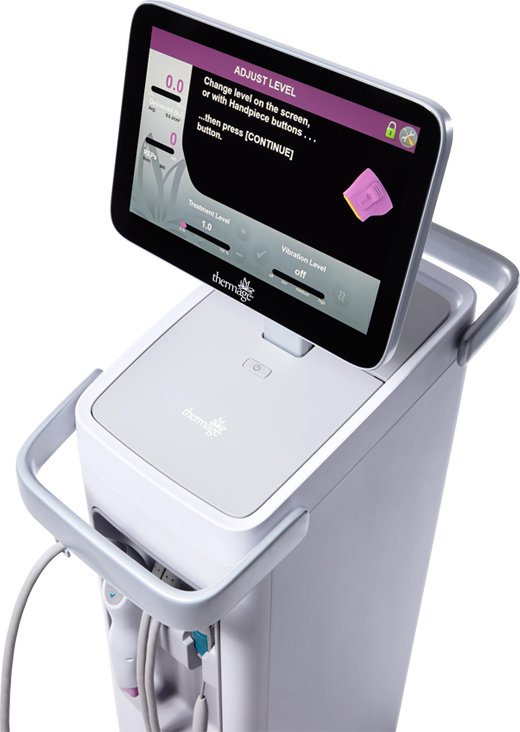
When researchers examined RF-treated skin under an electron microscope, collagen fibers looked thicker with blurred edges immediately after treatment, a sign of contraction. A few weeks later, type I collagen gene expression had risen and new collagen was forming [4]. Even when the surface shows almost nothing, the skin is still responding underneath. That's why Cheongdam RETOO Clinic uses the HeatView™ System to record, with a thermal imaging camera, exactly where heat was delivered. Capturing that invisible heat map during treatment gives us a reference point for reading your progress later.
Why do Thermage results keep improving for 2–6 months?
Your skin reads the heat in the dermis as a minor injury and starts repairing itself. Fibroblasts lay down new collagen and slack fibers are reorganized. That takes time, so measurable results appear gradually over 2–6 months after a single session [2]. It's also why clinical studies space their assessments weeks apart. A multicenter study of the eye area described early tightening from heat after a single treatment, followed by further tightening on a course similar to wound healing [5]. A study of loose cheeks and neck compared photos taken immediately and at 1 week, 1 month, 3 months and 6 months, and tightening was still present at 6 months [6].
- Right after treatmentTightening from collagen contraction · Redness fades within 24 hours
- A few weeksChanges gradually appear as new collagen forms
- 2–6 monthsRemodeling continues and measurable results appear
- 1–2 yearsHow long the result of one session lasts
To track your results, take photos in the same place, in the same light and with the same expression. If fine lines are your concern, take one photo relaxed and one smiling. If it's your jawline, keep your head at the same angle. And if your weight has changed significantly, any difference in your facial contour can't be put down to Thermage alone.
Thermage results seem slow. Did I get enough shots?
Slow-to-show results don't, on their own, mean the shot count or energy fell short. Thermage FLX's AccuREP™ technology reads skin impedance (electrical resistance) with every shot and adjusts the energy area by area [3]. Even so, how quickly your tissue responds afterwards depends on your starting firmness, the area treated and how you age. Shot count is set by skin thickness and your provider's judgment; it doesn't determine how fast you notice a change [1].
So if results feel slower than you expected, adding shots right away isn't the answer. Start by revisiting why you chose the treatment and which area you were targeting. If you were hoping to soften crow's feet but you're only comparing your face shape, you're measuring the wrong thing. And if you have a wedding, photo shoot or other big event coming up, count back 2–6 months from the date to pick your treatment day.
How long do Thermage results last, and when should I check in?
One session lasts 1–2 years depending on your skin and how you age, and many patients maintain it with one treatment a year [2]. Your interval is decided with your provider [1]. Follow-ups serve two different purposes: tracking results and dealing with any adverse reactions. If pain gets worse, or blisters, unusual sensations or pressure marks don't go away, don't wait for your next appointment. Contact the clinic [2].
When you ask "When should I come back?", also ask "What will we be looking at?" The assessment changes depending on whether texture, wrinkles or contour is the focus. When results appear and how long they last are separate questions, so look at each on its own terms.
Timing Thermage FLX around a trip to Seoul
If you're traveling to Seoul for treatment, the two-stage timeline above shapes your plan. On treatment day you may notice firmness along with redness, which usually fades within 24 hours, and swelling, which settles within a few days. The measurable change appears over 2–6 months, though, so most of it will happen after you're home. If your trip is tied to a wedding or photo shoot, the same rule applies: count back 2–6 months rather than booking just before the event.
It also helps to agree on a follow-up plan before you leave. We compare your pre-treatment records with records from the 2–6 month window under the same conditions, so ask at your consultation how and when that will work in your case. How long to stay in Seoul and when to follow up are decided at your consultation, based on your treatment and recovery.
Can I track my progress with photos from home?
Yes. The routine above works at home: same place, same light, same expression, and a fixed angle that clearly shows your area of concern. Photos like these, and any you send before your first visit, help show where your concern is and the direction you have in mind. What they can't show is skin thickness, remaining firmness or how the tissue is responding. That's why target areas, tips and shot count are decided at an in-person consultation using the 3D Precision Skin Diagnosis System. Please send photos of the area of concern only, and never photos of your passport or other ID.
How does Cheongdam RETOO Clinic assess Thermage results?
So that results aren't judged on feel alone, Cheongdam RETOO Clinic records a baseline before treatment. The 3D Precision Skin Diagnosis System captures wrinkles, pores, pigmentation and firmness under four light sources (standard, gloss, polarized and UV) and maps about 70 facial landmarks. Data from every scan is stored so changes can be compared and analyzed.
In a one-on-one consultation, Medical Director Dr. Kim Jae-rim sets the areas to improve and your goals, then plans your tip and shot count. During treatment, the patented HeatView™ System shows in real time where heat is reaching. Because we know exactly where and how much heat was delivered, the areas treated and the goal for each become the reference point when we review your progress.
- 01Pre-treatment recordsWrinkles, firmness and pigmentation captured with 3D skin diagnosis
- 02Setting goalsAreas to improve and how to assess them agreed one-on-one
- 03Treatment with HeatViewHeat delivery monitored as we treat
- 042–6 month comparisonPhotos under the same conditions to compare changes
If Thermage doesn't seem to have worked, first check two things: are you still within the 2–6 month window, and are you looking at the area you originally wanted to treat?
Frequently asked questions
How long does redness last after Thermage?
It usually fades within 24 hours, and swelling goes down within a few days. If it keeps getting worse or you think you have a blister, contact the clinic.
Can I get more treatment before I see results?
We don't recommend additional treatment before the 2–6 months it takes for new collagen to form. Note what you feel is missing and bring it up at your follow-up.
How should I take photos to track my progress?
Use the same place, light and expression, and pick a fixed angle that clearly shows your area of concern. At Cheongdam RETOO Clinic, we also compare your 3D skin diagnosis records.
I'm only in Seoul for a short stay. Will I see results before I leave?
You may feel some tightening right away, but with redness and swelling alongside it, and the measurable change appears over 2–6 months. Most of the result develops after you're home; how long to stay and your follow-up plan are decided at your consultation.
Related treatments
References
- Solta Medical Korea. Thermage® FLX – Frequently asked questions. Official website
- Solta Medical. Thermage FLX – FAQ · What to expect. Official website
- Solta Medical Korea. Thermage® FLX – How collagen regeneration works · AccuREP technology. Official website
- Zelickson BD, Kist D, Bernstein E, et al. Histological and ultrastructural evaluation of the effects of a radiofrequency-based nonablative dermal remodeling device: a pilot study. Arch Dermatol. 2004;140(2):204-209. doi:10.1001/archderm.140.2.204
- Fitzpatrick R, Geronemus R, Goldberg D, et al. Multicenter study of noninvasive radiofrequency for periorbital tissue tightening. Lasers Surg Med. 2003;33(4):232-242. doi:10.1002/lsm.10225
- Alster TS, Tanzi E. Improvement of neck and cheek laxity with a nonablative radiofrequency device: a lifting experience. Dermatol Surg. 2004;30(4 Pt 1):503-507. doi:10.1111/j.1524-4725.2004.30164.x
Planning a consultation in Seoul?
Send us your questions about this treatment. Our team will get back to you as soon as we see your message.
How to book a consultation
- 01Send us a message
Message us on WhatsApp or LINE. Tell us which treatment or concern you are interested in and when you plan to be in Seoul.
- 02Share photos if you wish
Photos of the area of concern only (no ID documents) help us talk about the general direction. The treatment plan itself is decided at the in-person consultation.
- 03Choose a consultation time
Our team suggests available dates and times, and your booking is confirmed once you choose one.
- 04In-person consultation
At the clinic, the doctor examines your skin and explains the treatment plan, recovery and cost before any treatment.
- 05Treatment and aftercare
After the treatment, we explain how to care for your skin, including what to keep in mind for your trip home.
Clinic Hours Weekdays 10:00–19:00 · Thu 10:00–21:00 · Sat 10:00–16:30 · Closed on Sundays and public holidays
Address 5–6F, First Light Tower, 417 Dosan-daero, Gangnam-gu, Seoul · 500m walk from Exit 4, Apgujeongrodeo Station (Bundang Line), across from the Mercedes-Benz Cheongdam Showroom · Hours & Location